

MCIC joined community development financial institutions (CDFIs) and mission-driven lenders at the 2026 Opportunity Finance Network conference in New Orleans to exchange ideas on expanding access to capital and strengthening community investment in Maryland.
Getting capital into communities is only part of community development finance. The rest is the relationships, policies, tools, and institutional capacity that keep that capital available, deployable, and accountable over time. MCIC is building that infrastructure now. The state created us by statute in 2024, so we are still early in the work of devising our approach.
First, a word on who we are. MCIC is not a CDFI. As a state instrumentality, our board structure puts us outside the certification. But we organize CDFIs across Maryland, we are incubating the Maryland CDFI Coalition, and as the state’s Community Development Entity ("CDE"), we are building the lending track record we need to compete for a New Markets Tax Credit allocation from the CDFI Fund. Day to day, much of our work looks like a CDFI’s, and we are asking the same questions about capital, capacity, and risk. We are working through those questions in the open, and we want your feedback and pushback along the way.
That is why we went to the Opportunity Finance Network ("OFN") conference, October 20–23, 2026. We came to learn from practitioners further along, test our strategy against theirs, and build partnerships that can move our work in Maryland forward. Three topics spoke most directly to our next steps: coalition building, artificial intelligence, and risk management.
What follows is what we heard, what it means for MCIC, and how we plan to put it to work.
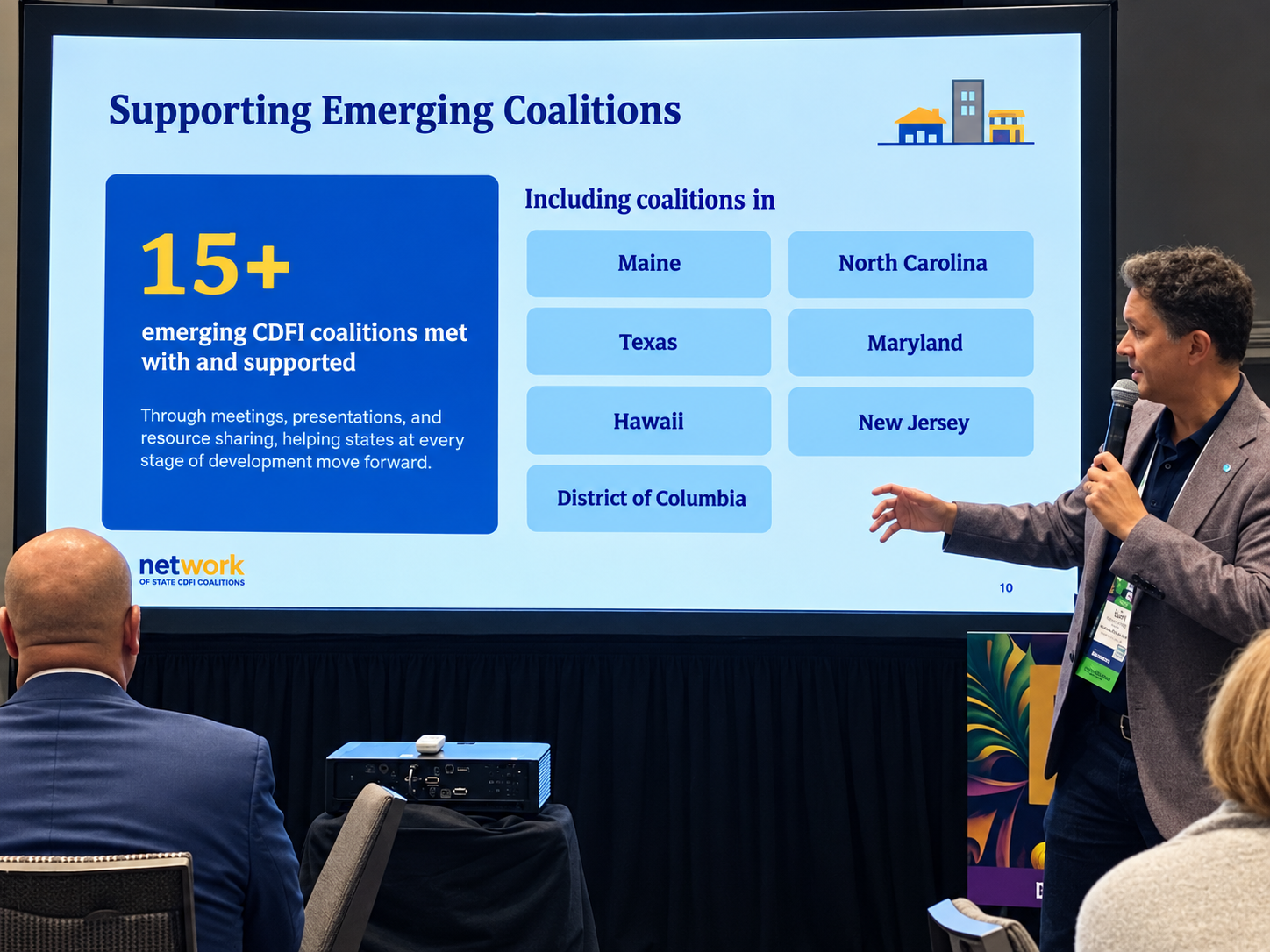
CDFIs share strategies for coalition building, policy advocacy, and collaboration to expand financing opportunities for underserved communities across Maryland and beyond.
Coalition Building: Finding Power in Collective Action
Throughout 2026, MCIC has been incubating the Maryland CDFI Coalition, convening a steering committee of lenders from across the state to envision a stand-alone entity that could strengthen their work through shared financial products, such as credit enhancements and revolving loan funds, and a unified voice in educating elected officials.
We arrived at OFN with two questions. How should governance balance the interests of regional CDFIs serving the DMV and Eastern Shore with major institutions like the Reinvestment Fund and Enterprise, which lend in Maryland and across the country? And what can a coalition offer when larger CDFIs already have policy teams and paid lobbyists?
MCIC explored both questions in an intimate session with the Network of State CDFI Coalitions. A state coalition’s value is not simply more lobbying, participants explained. It is collective capacity, and that capacity can benefit smaller and larger CDFIs alike.
Smaller CDFIs bring what larger institutions cannot easily replicate: firsthand knowledge of local markets, relationships with community organizations, and stories that decision makers might otherwise never hear. National organizations benefit from listening to the lenders closest to the communities they serve. Advocacy is more effective when local voices stand alongside policy experts, connecting legislative proposals to the realities on the ground. Smaller lenders also help developers build the balance sheet and expertise needed to pursue larger, more complex financing, strengthening the pipeline on which larger lenders can eventually draw.
A coalition can connect these complementary roles, pair local voices with national policy expertise, and link CDFIs to broader advocacy networks. Its governance must give smaller members meaningful influence while making room for larger institutions and potential partners, including community development banks. MCIC’s immediate priority is to gather and share practical resources, like bylaws, dues structures, and legislative advocacy day agendas, with our Maryland CDFI partners so our coalition can build on The Network’s growing expertise.
Artificial Intelligence: From Experimentation to Ethical Practice

MCIC explored responsible artificial intelligence (AI) applications in community development finance, including lending analysis, financial reporting, and data management, with an emphasis on data quality, security, and human oversight.
Artificial intelligence is already changing how lenders analyze data, manage operations, and make decisions. The question for MCIC is not whether to engage with these tools, but how to use them ethically and in service of our mission.
Governor Moore asked cabinet-level agencies to develop responsible AI policies last year, and MCIC has spent 2026 laying the groundwork for our own. Internal conversations have helped us understand how staff are using large language models ("LLM"), while discussions with peer organizations have revealed how differently institutions are approaching the technology. Some have built secure, closed environments using decades of lending data to inform future underwriting decisions. Others, particularly newer and smaller organizations with less "technical debt" to contend with, are using institutional AI accounts to accelerate data analysis for lending and accounting.
MCIC is already exploring practical applications. We have worked with ReBuild Metro and Maryland DHCD on an AI-powered production model to help Baltimore Vacants Reinvestment Initiative borrowers understand how to scale real estate production with the additional capital the program makes available. We have also consulted Moonwake Technologies, a Maryland-based firm specializing in AI strategy for CDFIs, and established a Governance Committee chaired by Secretary Rebecca Flora. With that groundwork in place, MCIC came to OFN to understand where the field is finding value, where it sees risk, and what responsible adoption should look like in practice.
A morning panel highlighted three practical applications.
Housing Development Fund demonstrated a platform which reviews lending documents, identifies missing information, and generates draft credit memos for human review, potentially reducing a day’s work to minutes.
Dakota Resources uses an LLM-powered accounting dashboard to turn QuickBooks data into budget-to-actual reports, covenant monitoring, financial statements, board packets, and forecasts.
Primary Care Development Corporation showed how an LLM can help organize and tag digital photo collections, distinguishing project images from stock photography and making archives easier to search.
Across these examples, the principle was consistent: automate repetitive work, protect sensitive data, and keep human judgment at the center of consequential decisions.
The day’s final session brought the conversation back to basics: AI is only as useful as the data behind it. Inconsistent records, duplicate entries, and manually corrected spreadsheets do not disappear with automation; AI can multiply their errors and accelerate bad decisions. The advice for organizations like MCIC was to start small, establish reliable "sources of truth," standardize data, and assign clear responsibility for its quality and governance. Moonwake also pointed us to Pacific Community Ventures’ AI Policy as a useful model. For MCIC, AI adoption begins not with a new tool, but with the disciplined data practices and clear rules that make any tool trustworthy.
Risk Management: Preparing for What Comes Next
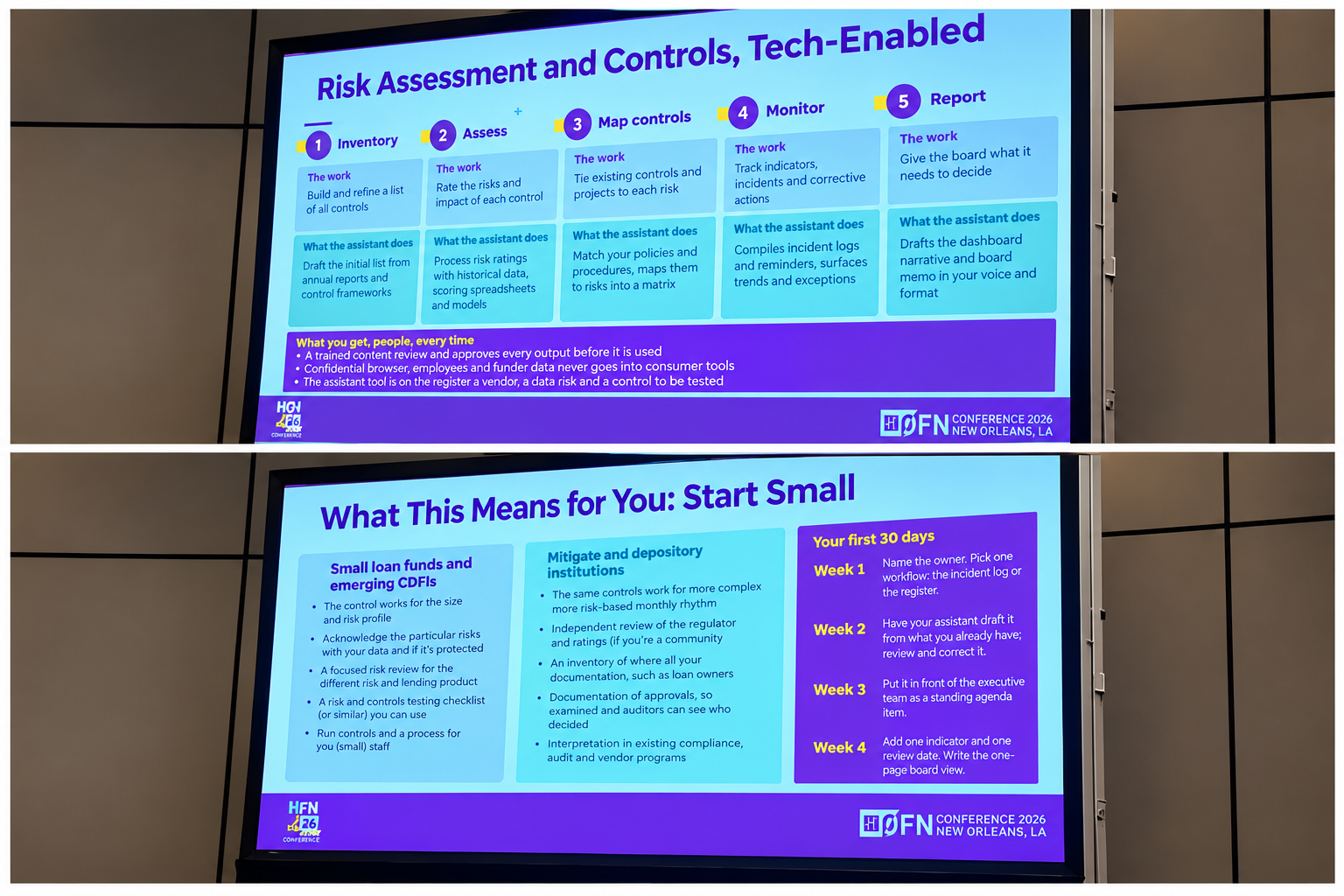
MCIC is applying lessons from CDFI peers to strengthen institutional risk management, build organizational capacity, and prepare to serve Maryland communities through economic uncertainty and unexpected disruptions.
Risk management in community development finance extends beyond protecting a balance sheet. It means anticipating disruptions, preserving the capacity to lend, and understanding how an institution can respond when vulnerable communities face unexpected shocks like economic downturns, natural disasters, or man-made disasters like the Key Bridge collapse. For an emerging lender like MCIC, the challenge is building the right safeguards without the resources of a much larger institution.
At OFN, we considered how peers approach institutional risk and what those practices might mean for a state-created financial intermediary. Back home, our ongoing work to assess MCIC’s capitalization strategy reflects the same principle: risk management is an organizational practice, not simply a compliance exercise.
Consider the potential impact of changes to the Community Reinvestment Act ("CRA"). MCIC could start by identifying its exposure, modeling how different CRA scenarios might affect bank lending and investment in community development finance, and assessing the implications for our capitalization strategy. Next, we could map existing safeguards, assign responsibility for monitoring relevant policy developments, and establish indicators to track changes in investment activity. Those indicators could feed into regular Governance and Audit Committee meetings, where leadership and board members review emerging risks, evaluate mitigation options, and determine when action is warranted. Technology can help organize the analysis, monitor indicators, and prepare board-ready reports. OFN's recommended framework is straightforward: identify the risk, assess its potential impact, map controls, monitor changes, and report findings to the people responsible for acting.
The message was encouraging. Organizations do not need sophisticated infrastructure to get started. With practical tools and consistent processes, lenders of every size can strengthen oversight, anticipate uncertainty, and protect their capacity to serve communities.
Bringing It Home
We’re bringing these lessons back to MCIC as we build the systems, partnerships, and practices that will help us serve Maryland communities for years to come. If you’re a Maryland partner navigating similar questions, we’d love to hear from you. Follow MCIC on LinkedIn and subscribe to our newsletter to stay connected as we put these lessons into practice.
The work of building a new institution is rarely glamorous, and we won’t always have every answer. But we believe in sharing what we learn along the way, because every lesson we put into practice today can help build a more capable, responsive, and resilient community development finance field tomorrow.