How MCIC Thinks About Community Ownership
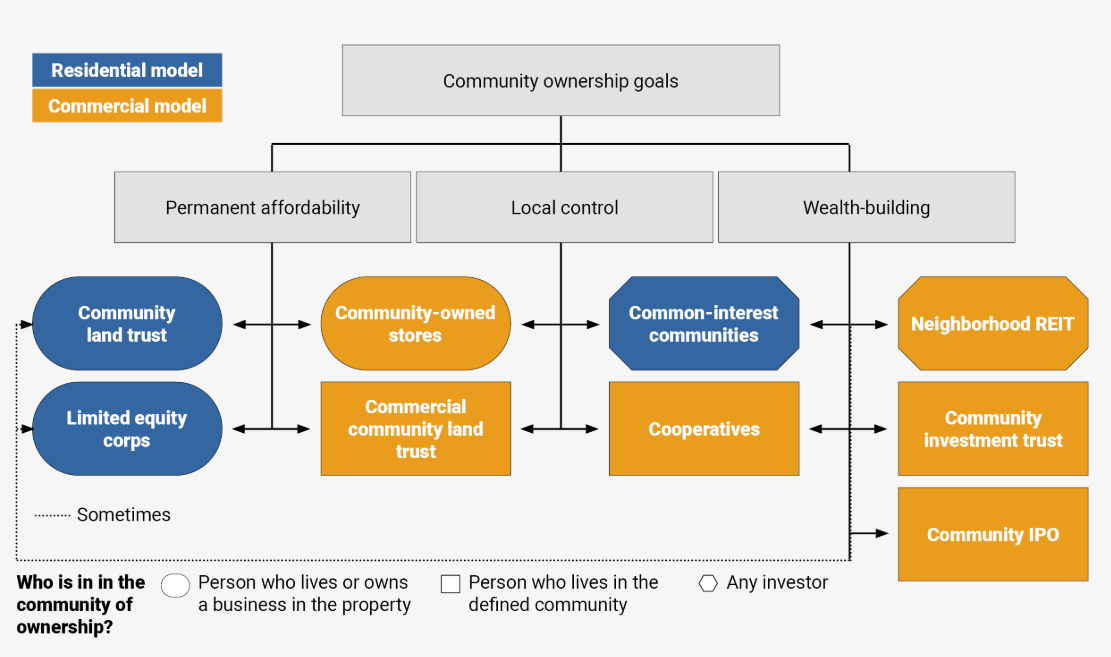
A taxonomy of community ownership models. Source: Brookings Institution.
At the Maryland Community Investment Corporation (“MCIC”), our mission is rooted in equitable development: expanding access to resources, fostering collaboration, and making catalytic investments that spark inclusive growth across Maryland.
That mission shows up most clearly in the places where Maryland's development challenges are most acute. Along the Purple Line Corridor, rising investment brings the risk of displacement. In the state's historic Black towns, sometimes called kinship communities, there is an urgent need to prevent Black land loss and advance racial healing. In Baltimore, community development corporations are working to strengthen neighborhoods while resisting speculation that can hollow them out.
Across these contexts, one idea keeps surfacing: community ownership.
Why Community Ownership?
Community ownership is not a new concept. It is deeply rooted in the Black freedom struggle and traditions of cooperative economics, powerfully documented by Jessica Gordon Nembhard. At its core, community ownership is about shifting who benefits from development, ensuring that the people who live and work in a place have a real stake in its future.
Today, that tradition is evolving into what ImpactAlpha has called the “ownership economy”: models that allow residents, tenants, and local entrepreneurs to build wealth through shared stakes in land, businesses, and real estate.
Maryland is already home to promising examples. Groups like the South Baltimore Community Land Trust are advancing permanently affordable housing and environmental justice through shared ownership of land. Invest York Road is experimenting with community shareholding along a major commercial corridor. And funds like Rochdale Capital are demonstrating that community ownership projects in places like Prince George's County and Baltimore can successfully absorb mission-driven financing.
If community ownership is such a compelling solution, the next question for MCIC is straightforward: Can we use New Markets Tax Credits (“NMTCs”) to support it?
The Financing Challenge (And How We're Working Through It)
MCIC was created by the State of Maryland to deploy New Markets Tax Credits, a federal financing program designed to channel capital into low-income communities. It has financed transformational projects across Maryland, and it remains at the heart of our work.
But federal tax credit financing was not originally designed with community ownership in mind. These transactions are built around stability: lenders and investors need assurance that a project's ownership structure will hold for years. That requirement creates friction with community ownership models, which are participatory by design and sometimes more fluid. Layer on questions about how community investors are treated for tax purposes during the compliance period, who provides loan guarantees when ownership is shared, and how securities laws apply when neighbors hold equity stakes, and you have a set of obstacles that have stopped more than a few promising deals.
We don't think those obstacles are insurmountable. We think they require creativity, the right partners, and someone willing to sit with the complexity long enough to work through it.
One approach we're watching closely: a nonprofit entity serves as the project owner during the financing compliance period, with a formal, structured commitment baked into the deal from day one to convey the asset to community members or tenant business owners once that period concludes. The community doesn't hold title immediately, but the transfer isn't an afterthought either. It's the whole point.
What MCIC Is Building
We want MCIC to be the place Maryland turns when community ownership meets development finance. In practice, that means:
Working alongside legislators to design financial products that can take shared equity models to scale because the policy infrastructure for this work is still being written.
Meeting neighbors where they are to help them understand what financing options exist to acquire and control the buildings and land that matter to their communities.
Connecting nonprofits across Maryland to mission-aligned capital, including CDFI loans and tax credit financing, that can make community ownership financially viable.
Reducing barriers for organizations trying to pair federal financing with community ownership goals, including taking on technical and compliance burdens ourselves when we're best positioned to do so.
Come Work With Us
Community-owned real estate isn't a niche idea. It is a strategy for economic inclusion, racial equity, and neighborhood stability. Maryland has the projects, the practitioners, and the political will to make it real.
If you are putting together a community-owned real estate project anywhere in Maryland and need help thinking through your financing options, MCIC wants to be your resource. Reach us at info@mdcommunityinvestment.com.